 Learn how to Grow and Use Acacia Plants
- for the enthusiast or commercial grower.
This course builds your ability to both identify and use different Acacias.
Wattles can be grown for a range or amenity purposes (eg. land rehabilitation, decorative garden plants, windbreaks etc), timber production, a cut flower, for tanning, as a food (bush tucker plant), etc.
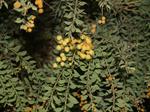
Their flowers are small, grouped in large numbers to create round balls or cylindrical spikes. These balls or spikes normally occur on peduncles (ie: a ball or a cylinder on the end of a stalk). They occur either singly, in pairs or racemes emerging from the axils of the leaves or phyllodes. The tiny flowers each have 4 to 5 sepals, 4 to 5 petals and numerous stamens. The fruit is a leguminous pod, often long. When mature, the pod will open releasing large hard coated seeds from inside.
In most species, there are no leaves. Instead, the plant has leaf like structures (considered to be modified petioles or leaf stalks), called "phyllodes".
Lesson Structure
There are 7 lessons in this course:
-
Introduction
-
Review of the system of plant identification, information sources, etc.
-
Plant reviews
-
Physiology of Acacias
-
Flower structure
-
Foliage types within the genus
-
Flower types within the genus
-
Acacia fruits
-
Plant reviews
-
Culture
-
Planting, staking, mulching, watering, feeding, pruning, etc
-
Plant reviews
-
Propagation
-
Methods of propagating Acacias.
-
Propagation of selected varieties.
-
Plant reviews
-
Acacias in the Garden
-
Landscape uses
-
Plant selection
-
Acacias for different situations (Cold hardy, drought hardy, humid climates, summer flowering, autumn flowering, etc)
-
The Design Process
-
Plant reviews
-
Other Uses for Acacias
-
Timber uses
-
Tanning
-
Cut Flowers
-
Food Source
-
Gum Arabic
-
Plant reviews
-
Pest & Diseases
-
Galls, Beetles, Weevils, etc
-
Environmental problems: Frost, Shade, Temperature, Wind
-
Special Project
-
PBL project where you plan the establishment of a collection of different cultivars of Acacias suited to growing in a specified locality.
Aims
-
Describe the way in which Acacias are classified.
-
Determine how to find reliable resource information that relates to Acacias
-
Describe the physiology of Acacias
-
Determine cultural requirements that are common to Acacias
-
Determine propagation methods that are commonly applicable to Acacias.
-
Describe a variety of commercial uses for Acacias.
-
Describe a range of other practical uses for Acacias.
-
Identify and recommend treatment for a variety of health problems occurring with Acacias.
-
Develop an in depth understanding of one aspect of Acacia Growing.
How to Propagate Wattles from Seed
Almost all Acacia species seeds have hard seed coats which will inhibit germination, hence need some treatment before the seeds are sown. The seed coats make it difficult for water to penetrate into the seed, which is necessary to initiate germination. Breaking the coat's surface therefore is necessary to ensure a good rate of germination.
How Hard?
The hardness of the seed coat is influenced by several things including:
- The variety of Acacia (some varieties have harder coats than others).
- The geographical location where the seed came from.
- The weather conditions which occurred over the period of time while the seed was developing on the plant
Seed Treatments
The most commonly used treatment is to pour near boiling water over the surface of the seed, then allow it to soak for between 1 and 24 hours before planting. Seeds that float after this soaking treatment are almost certainly not viable (discard those seeds).
Another method is to carefully cut a chip of the coat off with a sharp blade (eg: a Stanley knife). This must be done without damaging the soft tissue below the seed coat. The seed coat has also been broken successfully by rubbing seed between two sheets of fine sandpaper. Once again, the tissue below the seed coat must not be damaged.
Filing, cracking or burning with acid are other methods which can work, however due to the delicate nature of the tissue below the coat, they are not normally practiced.
- A few Acacia species have soft seed coats and do not require pre germination treatments (eg. A. argyrodendron, A. cambagei, A. harpophylla, A. peuce and A. xiphophylla)
- Some species will germinate readily from green seeds, harvested before they change colour in the pods, and sown immediately while still green.
- Seeds from very cold (snow prone) regions usually need soaking for longer (ie. Several days) if treated with boiling water. In nature these seeds would be exposed to a period of cold before germinating. As an alternative to the water treatment; such species may respond better to stratification (ie. Place seed in a sealed container and put into the refrigerator for 5 or 6 weeks before sowing).
WHY STUDY WATTLES?
“Wattles are commercially important plants in many ways, and many parts of the world, from Australia through Asia and the Middle East into Africa. They have unique value for land rehabilitation, and certain species are prized for timber, fodder and even food"
Quote from John Mason Dip.Hort.Sc. FIOH, FAIH, FPLA, MISHS, Garden Author and Horticultural Scientist
Studying any one group of plants in such depth will put you on the path to becoming somewhat of an expert with wattles.
This can be a valuable thing for many professions; from nurseryman, landscaper or horticulturist to environmentalist or botanist.
For others, wattles may simply be a passion.
What you learn here may be building on knowledge you already have, or it may be setting a foundation to continue learning more and more about Acacias after you graduate.
If you work with plants in any capacity, this course will be an asset in your career.
If you work more specifically with Acacias, this course may be a unique opportunity to grow your awareness, knowledge and skills set in ways that you might not easily achieve elsewhere.